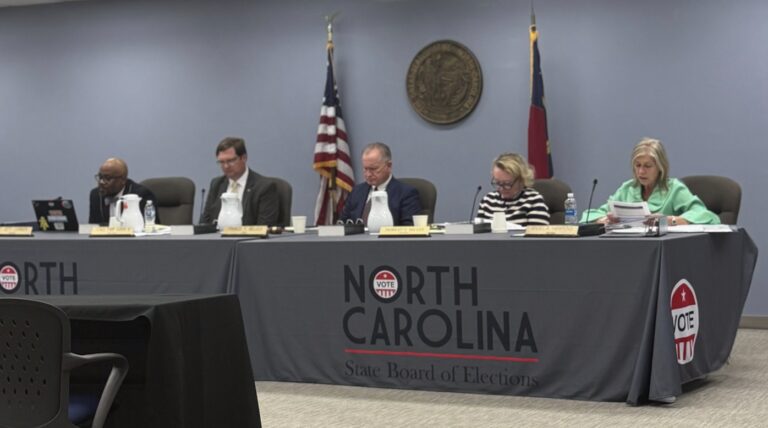
 RALEIGH, NC (April 16, 2026) – The North Carolina State Board of Elections has voted 3–2, along party lines, to adopt permanent rules (08 NCAC 23 .0101–.0104) that will use an unreliable federal database to challenge and remove North Carolinians from the voter rolls. Effective May 2026, these rules were adopted over the objections of more than 15,000 public commenters, multiple voting rights organizations, and legal experts who warned the State Board that it would disenfranchise thousands of lawful citizens.
“This Board was warned in documented and unambiguous terms that these rules would strip lawful citizens of their most fundamental right,” said Brian Kennedy, Senior Policy Analyst. “They heard 15,000 voices — neighbors, veterans, naturalized citizens, women who built lives in this state — and passed these rules anyway. This is not governance but a deliberate effort to strip lawful voters of their freedom to vote, right before an election that has clear implications on the future of our democracy.”
The rules rely on the federal SAVE (Systematic Alien Verification for Entitlements) database as the primary basis for challenging voters’ eligibility, a system the Board itself has previously acknowledged is “not a reliable indicator that a person is not a U.S. citizen.” In Missouri, 70 county clerks told their legislators that the SAVE system is flawed and regularly included “individuals we know to be U.S. citizens — our neighbors, colleagues and even voters we have personally registered at naturalization ceremonies.”
“Establishing these new rules based on an unreliable federal system in the middle of an electoral process will potentially deprive eligible voters, particularly naturalized citizens of Latino origin, of their right to vote in North Carolina,” said Veronica Aguilar, Communications Director for El Pueblo. “This will ultimately undermine the integrity and transparency of our elections and disenfranchise our most vulnerable voters.”
The rules also appear to conflict with federal law. The National Voter Registration Act prohibits systematic voter removal programs within 90 days of a federal election and the adopted rules contain no such protection. The U.S. Court of Appeals for the Eleventh Circuit has held that this prohibition exists because the risk of disenfranchising eligible voters is greatest immediately before an election, when a wrongfully removed voter has little realistic opportunity to fix their registration before casting a ballot.
More than 2.3 million North Carolina women who have changed their names may lack matching citizenship documents. Derived citizens — those who acquired citizenship through a parent’s naturalization — may have no paperwork at all, and obtaining a Certificate of Citizenship costs up to $1,385 and takes nearly three months. Rural voters may never receive notices due to postal disruptions, and notices will be issued only in English. Under Section .0104(c)(5), failure to appear at a challenge hearing — including one for which a voter never received notice — is treated as affirmative proof of non-citizenship, triggering permanent removal with no independent verification required.
“Under Section .0104(c)(5), a voter can be permanently removed from the rolls simply for missing a hearing. No independent verification required,” said Kennedy. “In 2016, this Board required confirmation before removing anyone, and that standard is now gone. What has changed is not the law, but the willingness to protect it.”
###
Democracy North Carolina is a statewide nonpartisan organization that uses research, organizing, and advocacy to increase civic participation, reduce the influence of big money in politics, and remove systemic barriers to voting and serving in elected office. Learn more at democracync.org.
El Pueblo’s mission is to build collective power through leadership development, organizing, and direct action so that the Latin American community and other marginalized communities control our own stories and destinies. Learn more at elpueblo.org.