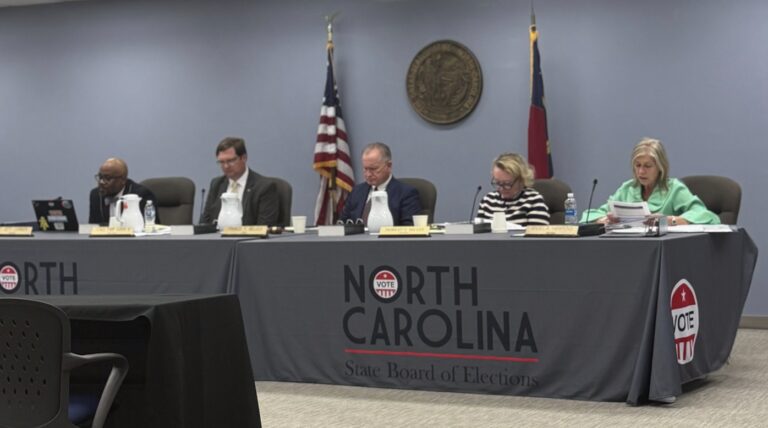
May 15, 2026 — The North Carolina State Board of Elections is the state agency responsible for administering elections across all 100 counties. It sets the rules that govern how ballots are cast, counted, and discarded. Its mandate is to ensure that elections are conducted uniformly, impartially, and accessibly for every eligible voter.
The Board has moved forward with proposed rule changes that fall short of that mandate — and the voters who will pay the price are the same voters North Carolina’s election laws have always burdened most: Black, brown, low-income, and young voters.
When the Board proposes a rule change, it must open a public comment period before that rule takes effect. Every comment submitted goes on the official record, and the Board must respond to substantive comments. A strong public response can slow, reshape, or stop a proposed rule entirely.
Amplified Sound at Polls
The board proposed updating rules around buffer zones, electioneering, and conduct at sites. What’s particularly concerning is new language on “amplified sound” near polling locations. This rule directly targets the community-led voter mobilization events that have done the most to bring Black, brown, and young voters to the polls.
Souls to the Polls has been a cornerstone of Black voter mobilization in North Carolina for years. In communities like Durham, Greensboro, and Charlotte, Black churches have organized transportation, music, and collective marches to early voting sites, turning Election Day into a community celebration and an act of resistance rooted in the long struggle for voting rights in this state.
Party at the Polls events from Raleigh to Wilmington have used music, food, and community energy to make voting feel safe and welcoming for voters who have every reason to distrust a system that has historically excluded them. Student March to the Polls at NC A&T, Western Carolina University, Duke, and NC Central University, has turned out hundreds of young voters, particularly young Black voters, who might otherwise have stayed home.
These events are not disruptions to the electoral process. They are the electoral process working as it should. They lower barriers, build trust, and bring eligible voters to the polls who would not otherwise come. Restricting amplified sound near polling locations would effectively shut them down.
Changes to Voter ID Exception Forms
Voters who rely on the ID exception form — those without access to a qualifying photo ID due to a lost document, lack of transportation, disability, or natural disaster — are already among the most vulnerable in North Carolina’s electoral system. On April 22, 2026, the North Carolina State Board of Elections moved forward with proposed rule changes that put those voters at even greater risk.
The state board has proposed changing how voter ID exception form ballots can be discarded, lowering the threshold from a unanimous vote to a simple majority. With all 100 county boards currently under single-party control, this is a direct threat to ballot access for thousands of North Carolinians. And with razor-thin margins deciding local and statewide races, the stakes could not be higher.
North Carolina’s photo voter ID law was reinstated in April 2023 when the newly Republican-majority state Supreme Court reversed its own ruling in Holmes v. Moore, which had struck the law down as racially discriminatory. Black voters make up 23% of registered voters in North Carolina, but 34% of those who are without a qualifying ID, and voter ID has been shown to suppress turnout among Black and brown voters even before they reach the polls. In 2024, voter ID was the second most common problem raised by callers to North Carolina’s Election Protection Hotline, and roughly 74% of voters who cast provisional ballots for lack of photo ID never returned with documentation and lost their votes entirely.
changes to absentee ballots
The proposed rule would change how county boards handle absentee ballots returned with minor, innocent mistakes. Right now, if a ballot arrives in a sealed outer envelope, county boards can count it, no questions asked. Under the proposed rules, three common mistakes would now require voters to submit written confirmation by noon on the Friday after Election Day or lose their vote: forgetting to seal the inner ballot envelope, placing the ballot in the wrong envelope, or two voters at the same address accidentally swapping their ballots into each other’s envelopes.
This change is unnecessary as existing guidance already gives county boards clear direction to handle these situations without contacting the voter. These proposed rules replace a common-sense standard with a bureaucratic hurdle that will fall hardest on the voters who rely on mail-in voting most — homebound voters, elderly voters, voters with disabilities, and voters displaced by natural disasters. The State Board should reject these rules and keep the guidance already in place.
The Big Picture
These rule changes are not isolated decisions. They follow a voter ID law that courts found was enacted with racially discriminatory intent, a shortened mail ballot return window, and a years-long pattern of election administration changes that consistently make voting harder for Black, brown, low-income, and young voters. Lowering the threshold to discard exception form ballots, silencing community mobilization events, and introducing unnecessary rules around absentee ballots are three parts of the same strategy.