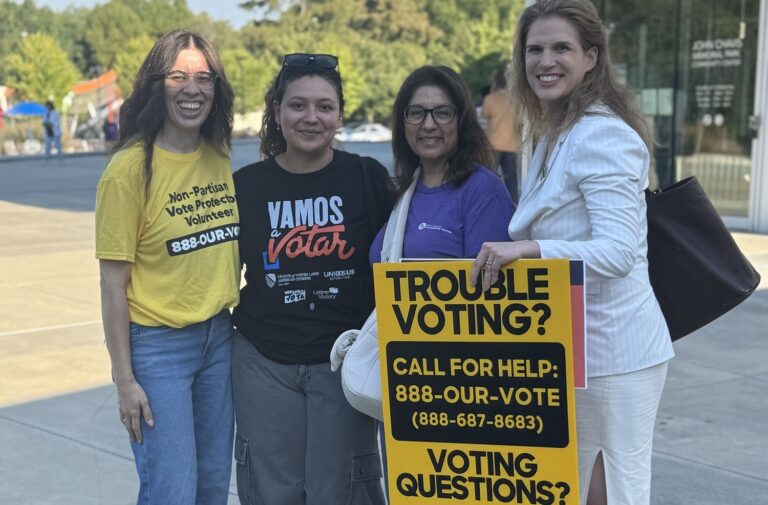
Morrisville, N.C. (October 16, 2026) — Hundreds of thousands of North Carolina voters converged on county polls on Thursday for the kick off of in-person Early Voting, running from October 15-31. In total, 201,609 votes were cast in person by day’s end, compared to 187,000 cast by the same point in the 2022 Midterms.
The state’s nonpartisan voter assistance hotline 888-OUR-VOTE, hosted by Democracy North Carolina in partnership with Southern Coalition for Social Justice and the National Lawyer’s Committee, received 153 calls on the first day of Early Voting, with 43 on the multilingual line hosted by North Carolina Asian Americans Together. Calls concerned rides to the polls, curbside voting challenges, long lines, third-party security patrolling, and aggressive electioneering, among other challenges.
Leading up to the election, Democracy NC worked with nonprofit organizations from across the state, collected thousands of pledges to vote, and reached thousands of North Carolinians through conversations and calls to help them make a voting plan for themselves and their families. We recruited and trained more than 300 volunteers to answer calls from across the state, from questions about voter registration and polling locations to reports of voter intimidation. On the first day of Early Voting, over 300 Vote Protectors through Democracy NC’s Election Protection program – which deploys assistance volunteers to poll during early voting and on Election Day – were located in 64 counties across the state.
Statewide voting rights and civil rights organizations held a press conference on Thursday highlighting their coordinated Election Protection efforts to assist voters, address emerging issues and threats, and protect access to the ballot. (Watch the full press conference here.)
“Dr. King spoke of ‘the fierce urgency of now,’ a call to act against injustice, poverty, and the forces that harm our communities,” said Kyle Brazile, Deputy Director of Democracy NC. “Democracy NC, alongside our partners, is answering that call.”
“Voting should be easy. Voting should be fun,” said Adrianne Spoto, Counsel, Voting Rights for Southern Coalition for Social Justice. “And voters shouldn’t have to deal with legislators or law enforcement putting up obstacles. Early voting sites shouldn’t be closed in the places that need them most.”
Brooks Fuller, Policy Director for Common Cause North Carolina, reflected on the tremendous community turnout in Columbus and Granville Counties this year in response to threats to close voting sites, when neighbors showed up in person at their local boards of elections and demanded change from their election administrators. “The lesson and what it says about the next several weeks and through state certification, is that good government happens when neighbors stand together, show up, get involved in the process, and hold their government accountable for more and for better,” Fuller said.
Speakers warned against the dangers of disinformation spreading online, with rumors designed to create confusion, and the importance of combatting disinformation as part of election protection work. “Widespread rumors of voter fraud, when stripped of context, are used to undermine public confidence and create fear among eligible voters as well as new barriers to the ballot box,” said Melissa Price Kromm, Executive Director of NC for the People. We are coordinating a rapid response to make sure voters have access to accurate, trusted information.”
“It’s no secret that Black communities have been historically disenfranchised,” said Dr. Jovita Lee Miller, Deputy Director of North Carolina Black Alliance, pointing out that vote protectors are covering 80% of all North Carolina counties, alongside roving attorneys with the Black Legal Network. “Having this level of on-the-ground support only enhances the experience of the voter and allows us to examine incidents in real time. Utilize our hotline 888-OUR-VOTE or flag down a poll monitor or attorney on site.”
Voters are encouraged to visit www.ncvoter.org and www.democracync.org for information about the election, including the three constitutional amendments on the ballot this fall (demnc.co/amendments and ncvoteagainst.org), or to call or text the hotline (888-OUR-VOTE) with any questions or challenges experienced at the polls, no matter how big or small. The hotline also connects with our partners on the Spanish and multilingual language lines. In North Carolina, individuals with prior criminal convictions with any challenges at the polls are encouraged to call 877-880-VOTE (8683). These voters are eligible to vote unless they have been convicted of a felony and have not yet completed their sentence (including probation, post-release supervision or parole).
“Your voice matters,” said Shruti Parikh, Director of Education and Political Engagement at NCAAT, emphasizing that citizens and naturalized citizens who received letters from the NC State Board of Elections this week regarding voter verification still have the right to vote. “This democracy belongs to you. Whether English is your first, second or fifth language, your right to vote is exactly the same. We believe that no one should have to navigate our democracy alone… eligible voters should not be frightened away from voting.”
“It takes all of us, each one of us stepping in and helping each other understand that we have a fundamental right to vote,” said Caitlin Swain, Executive Director of Forward Justice. “Those trying to turn back the clock are not going to succeed when we stand together.”
“We have witnessed throughout this election cycle [that] certain individuals in power have done everything they can to limit voter freedoms, as well as those who have bravely vowed to protect those precious freedoms,” Brazile said. “As a pro-voter, nonpartisan organization, we remain committed to working in collaboration with state election officials to ensure voter access across the state, and guarantee voters have the information they need to freely and safely cast their ballot.”