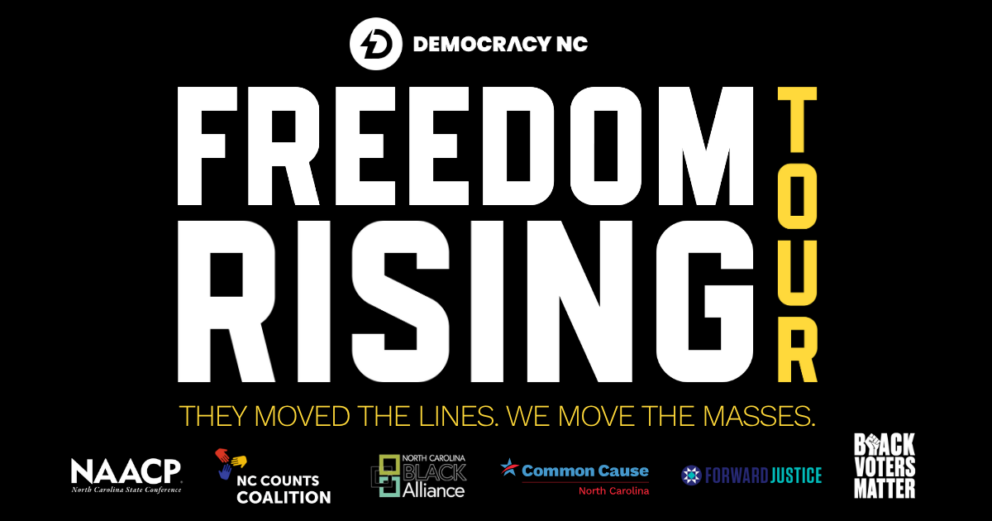
This summer, Democracy North Carolina, alongside Black Voters Matter, Common Cause NC, NC Black Alliance, NC Counts Coalition, Forward Justice, and the NC NAACP State Conference, will travel from the Black Belt communities of eastern North Carolina west to Charlotte, registering voters, training community ambassadors, and building the organizing infrastructure needed to bridge Black and brown political power statewide.
They moved the lines. we move the people.
Dates are being added and updated. Stay tuned!
JUNE
- June 27 — Charlotte, Mecklenburg County
Time: 11 a.m.–1 p.m.
Location: Arbor Glenn Recreation Center, 1520 Clanton Rd, Charlotte, NC 28217
JULY
- July 7 — Snow Hill, Greene County
Time: 6 p.m. – 8 p.m.
Location: Greene County Community Center, 814 W. Harper Street, Snow Hill, NC 28580
- July 10 — Greenville, Pitt County
Time: 6 p.m. – 8 p.m.
Location: Philippi Church of Christ 3760 Philippi Dr, Greenville, NC 27834
- July 11 — Warrenton, Warren County
Time: 11 a.m. – 1 p.m.
Location: The Front Porch Grocery Co-op, 307 E Macon Street, Warrenton, NC 27589 - July 11 — Laurinburg, Scotland County
Time: 12 p.m. – 2 p.m.
Location: Bethlehem Missionary Baptist Church, 439 Stewartsville Rd, Laurinburg, NC 28352 - July 14 — Tarboro, Edgecombe County
Time: 6 p.m. – 8 p.m.
Location: Tarboro Coffee House, 439 N Main St, Tarboro, NC 27886
- July 23 — Wilson, Wilson County
Time: 6 p.m. – 8 p.m.
Location: Darden Alumni Center, 1600 Lipscomb Rd E, Wilson, NC 27893 - July 28 — Havelock, Craven County
Time: 6 p.m. – 8 p.m.
Location: New Beginnings Ministry of Faith, 30 Park Ln O, Havelock, NC 28532 - July 30 — Jacksonville, Onslow County
Time: 6 p.m. – 8 p.m.
Location: Rock of Deliverance Ministries, 123 Henderson Dr, Jacksonville, NC 28541
AUGUST
- August 1 — Fayetteville, Cumberland County
Time: 12 p.m. – 2 p.m.
Location: Cliffdale Recreation Center, 6404 Cliffdale Rd, Fayetteville, NC 28314 - August 1 — Roanoke Rapids, Halifax County
Time: 11 a.m. – 1 p.m.
Location: Center for Energy Education, 460 Airport Rd, Roanoke Rapids, NC 27870 - August 6 — Goldsboro, Wayne County
Time: 6 p.m. – 8 p.m.
Location: First African Baptist Church, 803 Harris St, Goldsboro, NC 27530 - August 8 — Winston-Salem, Forsyth County
Time: 11 a.m. – 2 p.m.
Location: Goler Memorial AME Zion Church, 3894 Northampton Drive, Winston Salem, NC 27105 - August 15 — Lillington, Harnett County
Time: 10 a.m.–12 p.m.
Location: Harnett County Public Library, 455 McKinney Pkwy, Lillington, NC 27546 - August 22 — Windsor, Bertie County
Time: 10 a.m.–12 p.m.
Location: Mount Olive Missionary Baptist Church, 102 Mt Olive Rd, Windsor, NC 27983 - August 29 — Raleigh, Wake County
Time: 10 a.m.–12 p.m.
Location: Watts Chapel Missionary Baptist Church. 3703 Tryon Rd, Raleigh, NC 27606
“Freedom Rising” Didn’t Begin When the VRA Ended
On April 29, 2026, the Supreme Court issued one of the most consequential voting rights decisions in American history. In Louisiana v. Callais, six justices gutted Section 2 of the Voting Rights Act, the legal framework built in a North Carolina courthouse in 1986 by Black North Carolinians Ralph Gingles and Julius Chambers. Plaintiffs must now show circumstances giving rise to a “strong inference of intentional discrimination,” a standard Congress deliberately never wrote into the law. Justice Kagan wrote in dissent that the decision renders Section 2 “all but a dead letter.” Within days, active lawsuits in North Carolina’s Black Belt were dismissed because the legal standard had been destroyed.
In North Carolina, the attack on Black political power did not begin with Callais. The Republican-controlled legislature has drawn six congressional maps in six years, each one targeting Black communities with greater precision. Congressional District 1, the historic Black Belt district that has not elected a Republican since 1883, has been surgically dismantled multiple times.
Freedom Rising is our response. They moved the lines. Now we move the people.
the fight for fair maps in north carolina
Within days of the gutting of the Voting Rights Act, active lawsuits in North Carolina’s Black Belt were dismissed because the legal standard had been destroyed. They moved the lines. Now we move the people.
… In the HISTORIC BLACK BELT, where Princeville was chartered by freed people in 1885 as the first Black-governed town in the United States, where Halifax County organizers won voter registration victories in federal court a full year before the Voting Rights Act passed, and where Eva Clayton broke barriers in Congress in 1992 only to watch the legislature dismantle her district at age 91.
… In FAYETTEVILLE, where seven Black citizens pooled $136 in 1867 to build what became Fayetteville State University, the first state-supported school for Black students in North Carolina. Where FSU students and Fort Bragg soldiers desegregated downtown together in 1963, a year before the Civil Rights Act. That coalition of HBCU students and Black military voters is exactly what the 2025 maps targeted by cracking Fayetteville apart into multiple congressional districts. And where a Fayetteville city council member was a named plaintiff in Covington v. North Carolina, the 2016 case that struck down 28 legislative districts as racial gerrymanders.
… In DURHAM, where Black Wall Street thrived on Parrish Street before urban renewal drove a freeway through it. Where NC Central University opened as the nation’s first state-supported liberal arts college for Black students, and Julius Chambers learned the law before arguing Thornburg v. Gingles before the Supreme Court, giving Black voters their most powerful legal tool for forty years.
… In GREENSBORO, where four NC A&T freshmen sat at a Woolworth’s lunch counter in 1960 and sparked a sit-in movement across 30 cities in 7 states. Where labor and racial justice organizers were shot and killed by the KKK in 1979, and the community kept organizing anyway. And where the largest HBCU in the United States has trained generations of Black leaders who never believed the courthouse was the only place power lives.
… In CHARLOTTE, where Julius Chambers argued Swann v. Charlotte-Mecklenburg and then Thornburg v. Gingles and won. Where Congressional District 12 became the national symbol of racial gerrymandering, and where every major redistricting case from Shaw v. Reno to Cooper v. Harris ran through the community’s front door.
These communities organized before the law caught up, and they will continue to organize fervently until justice is served again. That rooted, relentless, sovereign power is what Freedom Rising is built on. From the Black Belt to Charlotte, statewide advocates will be on the ground registering voters, training community ambassadors, and building the organizing infrastructure needed for November and beyond.
Don't Sit This One Out: Key Dates for the 2026 Midterms
- Register to Vote! Deadline: October 9, 2026 by 5 p.m.
- Early voting begins (with same-day registration): October 15, 2026
- Absentee ballot request deadline: October 20, 2026 by 5 p.m.
- Early voting ends: October 31, 2026 at 3 p.m.
- Election Day: November 3, 2026 — polls open 6:30 a.m. to 7:30 p.m.
- Provisional ballot ID deadline: Noon, November 6, 2026 — bring acceptable photo ID to county board of elections
- County canvass: November 13, 2026 at 11 a.m.