Democracy North Carolina – Joselle Torres, press@democracync.org
Southern Coalition for Social Justice – Melissa Boughton, 830-481-6901, melissa@scsj.org
DURHAM, N.C. (September 14, 2026) – Voters’ experiences during the 2024 Election confirms the continued need to improve voting policies, access, and transparency around voting, according to a new Election Protection report from voting rights groups Democracy NC and Southern Coalition for Social Justice (SCSJ). Even two years out, every barrier documented in the report, from confusing deadlines and inconsistent photo ID enforcement to mail-in ballot rejections and voter intimidation, remains unresolved heading into the 2026 midterms.
Democracy NC and SCSJ, with support from the Lawyers’ Committee for Civil Rights Under Law and state partners within the NC Election Protection Coalition, staffed the statewide non-partisan voter assistance hotline (888-OUR-VOTE) throughout the 2024 election cycle to serve as a trusted, non-partisan source of accurate information for voters statewide. The 2024 Election Protection report includes analysis of over 6,460 calls voters made to the hotline, with every call revealing the pervasive challenges voters continue to face in casting their ballots – despite claims by certain policymakers and election administration that voting is “too easy” to justify new restrictions and barriers to the ballot box.
This report casts light on the obstacles voters face and opportunities to improve the election system for all North Carolinians in five major areas raised frequently by callers: voter registration, voter photo ID, voting by mail, voter intimidation and electioneering at the polls, and disability access.
Recommendations in the report based on these areas include:
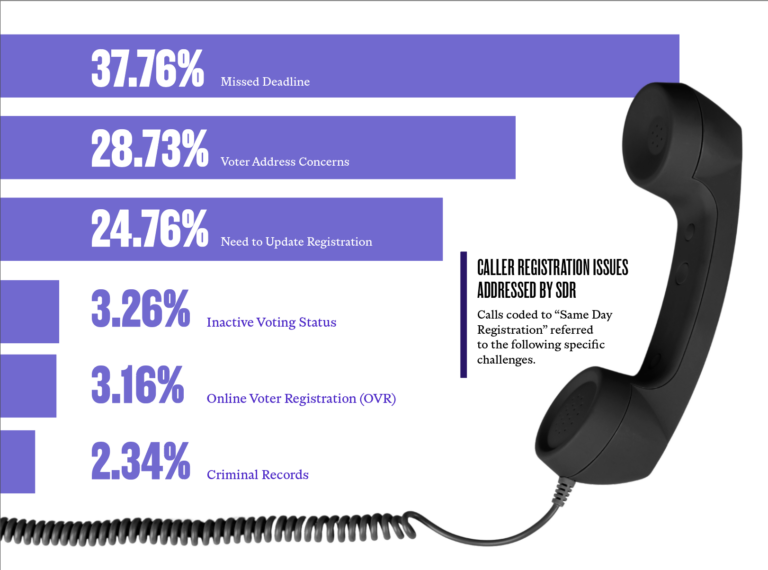
- Extend same-day registration beyond early voting to Election Day; allow Election Day changes to out-of-county registrations; adopt automatic voter registration; and expand online voter registration.
- Improve and increase training for county boards and poll workers when it comes to implementation of the voter ID law; continue outreach to colleges and universities around the student ID approval process; approve usage of digital photo IDs as voter photo IDs; and increase community outreach about availability of free voter photo ID.
- Create permanent vote-by-mail lists – allowing voters who opt in once to automatically be sent a ballot by mail in every subsequent election; permit ballot drop boxes; and adjust receipt and postmark deadlines for mail ballots so that ballots cast by Election Day are not discarded due to issues with mail delivery.
- Improve public education and reporting systems around voter intimidation and harassment; improve election official training around unlawful intimidation and implicit bias; and contingency planning to respond swiftly if these events unfold.
- Require election official training on Americans With Disabilities Act (ADA) andHelp America Vote Act (HAVA) to increase volunteers’ and officials knowledge and informing voters themselves of their rights; create accessible voting “know your rights” campaigns for disabled voters;; require voting sites audits for physical accessibility; and increase resources for language accessibility.
To highlight some numbers of note:
- 2,708 mail ballots were rejected solely for arriving after Election Day in 2024 (after the removal of the prior three-day grace period), larger than the number of votes that decided a statewide contest that year.
- 62% of provisional ballots were rejected, 89% of those for registration-related reasons.
- 550 Hotline callers could have had their issues resolved if same-day registration extended to Election Day.
- 35 minutes to 4 hours – the wait time Hotline voters reported for curbside voting.
Although many election administrators across the state are working to address some of these concerns, lawmakers as well as some of those working at the state-level election administration level continue to validate extreme claims related to fraud or disinformation by changing election laws under the guise of “election integrity.” This is particularly evident in bills proposed throughout the 2026 session, including House Bill 958 which would – among a long list of election changes – shorten early voting for Primary elections, allow for more voter challenges if a candidate isn’t happy with an election’s outcome, and compel the state DMV to provide personal identifying information from its driver records (including full social security numbers) to the NC State Board of Elections for expanded list maintenance activities.
This kind of complex, convoluted, wide-ranging legislation further proves the need to center the experiences of voters – as evidenced by this report – in policy changes in North Carolina when it comes to improving election administration. After all, the thousands of voters who receive assistance from the hotline represent only a fraction of eligible voters in the state who are navigating the complexities of our voting systems with little to no assistance.
“Every barrier in this report has a known fix,” said Adrianne Spoto, Counsel for Voting Rights at SCSJ. “North Carolina doesn’t need more restrictions dressed up as ‘election integrity;’ it needs same-day registration on Election Day, consistent poll worker training, a vote by mail process that doesn’t throw out valid ballots over a mail delay, and more intentional processes for people who need accommodations.”
“We have increasingly witnessed efforts by our government to silence voters, at a time of tremendous uncertainty in our nation, with lawmakers ignoring the needs of their constituents in an effort to consolidate their own power,” said JP Grillet, Election Protection Manager for Democracy NC. “We stand ready to respond to those efforts. We and our partners are committed to continuing taking calls, offering support, protecting the vote, and making sure the voices of all voters are heard at the ballot box, in 2026 and the years to come.”
The 2026 Election Protection report offers recommendations and actionable steps for lawmakers and the State Board of Elections to protect voters through improving voting by mail, early voting, accessibility, and more. Learn more at demnc.co/epreport.
###
Democracy North Carolina is a statewide nonpartisan organization that strengthens democratic structures, builds power among disenfranchised communities, and inspires confidence in a transformed political process that works for all. Learn more at www.democracync.org.
Southern Coalition for Social Justice, founded in 2007, partners with communities of color and economically disadvantaged communities in the South to defend and advance their political, social, and economic rights through the combination of legal advocacy, research, organizing, and communications. Learn more at southerncoalition.org and follow our work on Twitter, Facebook, and Instagram.