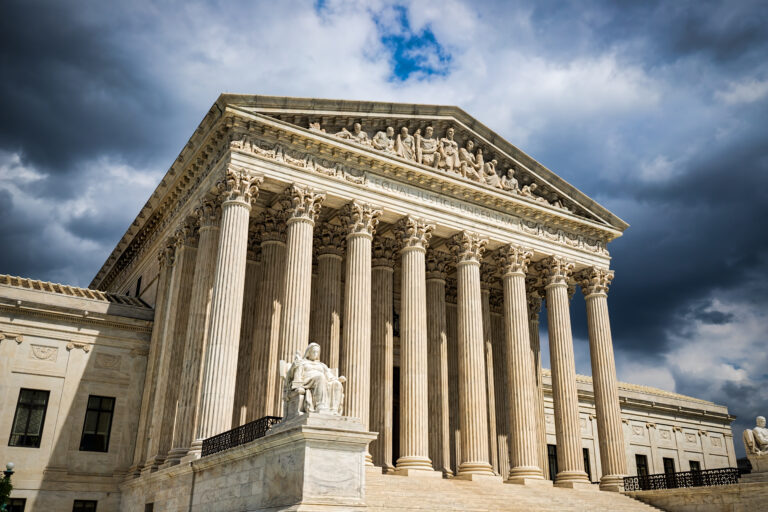
RALEIGH, N.C. — Today, the Supreme Court issued its 6-3 decision in Louisiana v. Callais, effectively gutting Section 2 of the Voting Rights Act, the last major federal protection against racially discriminatory electoral maps.
Writing for the majority, Justice Samuel Alito held that Louisiana’s court-ordered second majority-Black congressional district was itself an unconstitutional racial gerrymander, and quietly rewrote Section 2 to require proof of intentional discrimination, a standard Congress explicitly rejected in 1982. A plaintiff will now have to show, contrary to Section 2’s clear text and design, that legislators were motivated by a discriminatory purpose.
Justice Elena Kagan, joined by Justices Sonya Sotomayor and Ketanji Brown Jackson, did not mince words. The consequences, Justice Kagan warned, “are likely to be far-reaching and grave,” and today’s decision renders Section 2 “all but a dead letter.” In states where that law continues to matter – states still marked by residential segregation and racially polarized voting – Black and other non-white voters can now be cracked out of the electoral process. The majority, Justice Kagan wrote, holds that the Voting Rights Act “must be brought low to make the world safe for partisan gerrymanders.” And in her closing, she was unsparing, saying this ruling marks “the latest chapter in the majority’s now-completed demolition of the Voting Rights Act.”
Justice Kagan was right. And North Carolina, with its storied and ongoing battle around racially discriminating gerrymandering, is exactly the state she was warning about.
“Today’s ruling is a profound betrayal, but it is not a surprise, and it will not be the final word,” said Adrienne Kelly, Executive Director of Democracy North Carolina. “The Roberts Court has spent two decades methodically dismantling the legal architecture of the Civil Rights Movement. Today, it all but finished the job. But Black voters in North Carolina’s First Congressional District, and across this state, have faced worse and prevailed. And we will prevail again, with the support of all North Carolinians, of all political stripes, that believe in the power of the people to exercise their 15th Amendment.”
North Carolina did not arrive at today’s crisis by accident. Few states have seen more landmark gerrymandering cases, and few legislatures have more consistently worked to diminish Black political power.
The story begins with Shaw v. Reno (1993), born from North Carolina’s own congressional map, which launched three decades of litigation over CD1 and CD12 – districts redrawn, challenged, and struck down repeatedly. In Cooper v. Harris (2017), the Supreme Court ruled 5-3 that the state had unconstitutionally packed Black voters into both districts. The legislature’s response was to switch from racial to partisan gerrymandering – openly, on the record.
Federal courts validated that strategy in Rucho v. Common Cause (2019), a North Carolina case, closing the federal courthouse door to partisan gerrymandering claims. Covington v. North Carolina separately found 28 state legislative districts to be unconstitutional racial gerrymanders. When the state Supreme Court briefly offered relief in Harper v. Hall (2022), the legislature waited, flipped the court’s majority, and watched it reverse course.
Today, that history reaches its conclusion. NAACP North Carolina State Conference v Berger, a case pending before the Fourth Circuit, alleges that current Republican maps have left CD1, a district built through decades of civil rights struggle, with only approximately 30% Black voting-age population. Under today’s ruling, that challenge is effectively dead on arrival. Those same maps were used in 2024, when Republicans converted a 7-7 House delegation into a 10-4 advantage.
“I want Black voters across the First Congressional District and every corner of this state to hear me clearly: your vote has not been taken from you,” said Kelly. “Maps can be redrawn. Courts can be wrong. Majorities shift. What cannot be taken, what has never been taken, through Jim Crow, through massive resistance, through every attempt to silence this community, is the will of Black North Carolinians to be seen, to be heard, and to determine their own future. That will is what we carry into this fight today, tomorrow, and with every election ahead.”
###
Democracy North Carolina is a statewide nonpartisan organization that uses research, organizing, and advocacy to strengthen democratic structures, build power among disenfranchised communities, and inspire confidence in a transformed political process that works for all.