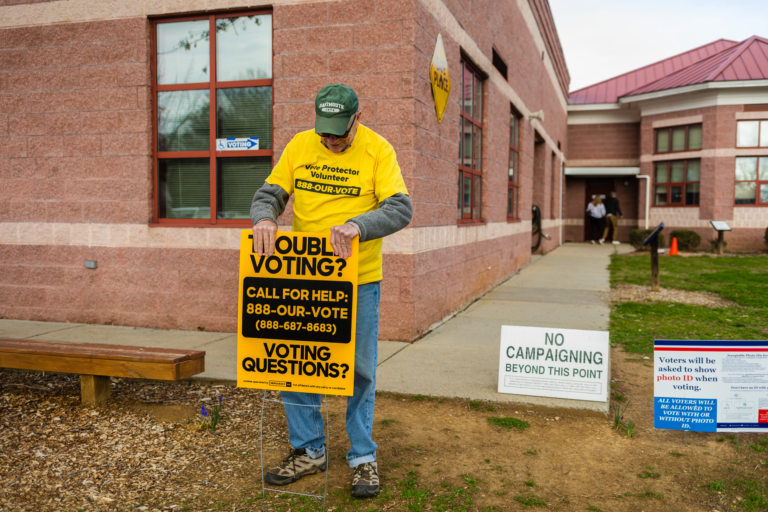
NORTH CAROLINA (March 4, 2026) — In the face of escalating threats to voting rights across the U.S., North Carolina voters showed up in historic numbers for the 2026 Midterm Primary Election. Early voting totals for the primary surpassed both the 2022 midterm primary and the 2024 presidential primary, running 21% higher and 1% higher, respectively. The scale of participation reflects the urgency voters are feeling about this midterm election and the stakes it carries.
This cycle, voters had to navigate a landscape of confusion and obstacles engineered at the administrative level. Just weeks before early voting began, the North Carolina State Board of Elections sent letters to more than 241,000 registered voters notifying them that they did not have a driver’s license number or partial Social Security number in their voter registration file that was validated when matched to government databases. The board acknowledged that mismatches were frequently caused by minor discrepancies — hyphens, apostrophes, name changes, typos — with no bearing on voter eligibility. Yet for hundreds of thousands of voters, many of them in vulnerable communities, the letters arrived without clear explanation and with the unmistakable implication that their registration was in question.
Groups from across the election protection and social justice space, including Democracy North Carolina and Southern Coalition for Social Justice (SCSJ), mobilized to meet voters where they were, on the ground, at the polls, and on the phone, ensuring every eligible North Carolinian could exercise their fundamental freedom to vote, no matter the obstacle.
“What we are witnessing is communities refusing to accept the erosion of their political power,” said Adrienne Kelly, Executive Director of Democracy North Carolina. “Black voters, working-class voters, young voters, elderly voters, and voters in rural counties who have been told in a thousand different ways that their participation is inconvenient — they showed up anyway. Our job is to make sure every single ballot is counted.”
“Voting should be a celebration, not a struggle,” said Adrianne Spoto, Counsel for Voting Rights at Southern Coalition for Social Justice. “But as long as state and federal officials keep trying to silence voters, we will be here to support North Carolinians in making their voices heard.”
Democracy NC and SCSJ will be reviewing preliminary data throughout the week as Election Day ballots are counted and provisional ballots are processed. Some initial data points of note*:
- 702,796 registered voters cast ballots during in-person early voting, with an additional 26,042 casting absentee by-mail ballots. Together, early voters made up 9.46 percent of all registered voters, outpacing the early voting share from the 2024 presidential election at 9.36 percent. Early voters made up just 4.1 percent of registered voters in the 2018 primary and 7.7 percent in 2022.
- Registered Democratic early voters outnumbered registered Republican early voters by roughly 96,000 ballots heading into Election Day. Voters under 45, Millennials and Gen Z, made up 16 percent of early ballots, remaining an underrepresented and urgently needed voice in this electorate.
- 5,249 voters utilized same-day registration during the early voting period. Black and brown voters were more than twice as likely to use same-day registration as white voters. These voters were also significantly younger, with an average age of 41, compared to an average age of 63 years old for all early voters.
*These numbers will not be finalized until Election Day ballots are counted and the post-election canvass is completed. Those interested in being part of the canvassing process can learn more at demnc.co/canvass.
The nonpartisan voter protection hotline (888-OUR-VOTE), operated by Democracy NC and SCSJ in partnership with the Lawyers’ Committee for Civil Rights Under Law, fielded over 280 calls during the early voting period and on Election Day. Democracy NC deployed Vote Protectors across NC to help field questions in real time and equip voters with the tools needed to cast their ballots safely and securely. Election protection efforts included:
- DMV Registration Delay – A voter registered at the DMV but did not appear in the online voter search tool because they registered after the February 6 deadline. This meant the registration would not be processed until after the election, but hotline volunteers were able to direct them to use same-day registration so they could still cast a ballot during the early voting period.
- Right to Vote While in Line – A voter called on Election Day when poll workers said people in line before 7:30 p.m. could not vote after that time, in violation of state law. Hotline volunteers confirmed for the voter that North Carolina law protects the right of voters in line by closing time to cast a ballot; the voter relayed this, urging others to remain in line, and poll workers eventually did allow everyone in line to vote.
- Voters Wrongly Turned Away – Poll workers in one county incorrectly turned away registered voters. Hotline volunteers confirmed voters’ registration so they could return and vote, and alerted the County Director, who issued additional guidance to poll workers.
Democracy NC and SCSJ will now shift their full attention to the post-election canvass — the process by which every county board of elections verifies that votes have been counted correctly, required audits have been completed, and results are officially certified. For this primary, county boards will convene their Day of Canvass meetings at 11 a.m. on the 10th day after the election, gathering to compile results from all precincts, authenticate every ballot type, and make the official report of the outcome within their county. Provisional ballots, absentee by-mail ballots, and any ballots flagged under the Registration Repair Project will all be subject to review during this period.
“The statewide canvass is where the rubber meets the road. For communities that have long been pushed to the margins of our democracy, the counting of every ballot isn’t a technicality, it’s justice due,” said Brian Kennedy, Senior Policy Analyst for Democracy NC. “As the State Board looks for new ways to disenfranchise voters, our community advocates will continue to show up, monitor public meetings, and ensure every valid vote cast is counted.”
###
Democracy North Carolina is a statewide nonpartisan organization that uses research, organizing, and advocacy to strengthen democratic structures, build power among disenfranchised communities, and inspire confidence in a transformed political process that works for all. Learn more at democracync.org.
Southern Coalition for Social Justice, founded in 2007, partners with communities of color and economically disadvantaged communities in the South to defend and advance their political, social, and economic rights through the combination of legal advocacy, research, organizing, and communications. Learn more at southerncoalition.org.